A field sobriety test Michigan officers use at the roadside is a set of physical and eye-movement exercises that helps an officer look for signs associated with impairment. It is not a measurement of blood alcohol concentration. It cannot show a specific BAC, and a poor performance does not automatically mean a driver committed an OWI offense. Officers weigh the results alongside driving behavior, speech, odor, statements, and any breath or chemical test. How the tests were given, and the conditions at the roadside, affect how much the results mean.
_________________________________________________________________________
If an officer asks you to perform field sobriety tests, what do those tests actually prove? Less than most drivers assume. Every field sobriety test Michigan officers request is one piece of a larger OWI investigation. The results can shape an officer’s observations and next steps. They are not a chemical measurement of alcohol concentration.
That difference drives everything else here. A roadside test records how a person performed a task, at one moment, under specific conditions. Below, we cover what officers look for, where the tests fall short, and what Michigan law says about declining them.
Key Takeaways
- What they measure: balance, coordination, eye movement, and the ability to follow instructions while dividing attention. They do not measure BAC.
- The three standardized tests: horizontal gaze nystagmus, walk-and-turn, and one-leg stand.
- What results can establish: officer observations. These are weighed with other evidence and do not alone prove a BAC or an OWI offense.
- Testing rules differ: Michigan treats roadside exercises, preliminary breath tests, and post-arrest chemical tests differently.
- Context matters: surface, footwear, lighting, health, and the instructions given all affect what a result means.
What Is a Field Sobriety Test in Michigan?
A field sobriety test is a roadside exercise an officer uses to look for signs of impairment during an OWI investigation. The exercises are physical and observational. A driver may be asked to balance, walk a line, or follow an object with the eyes.
Four things are often confused:
- Field sobriety tests: roadside exercises judged by the officer’s observations. They produce no alcohol reading.
- Preliminary breath test (PBT): a handheld roadside breath device, addressed separately in MCL 257.625a.
- Chemical tests: breath, blood, or urine tests after arrest. The statute makes results admissible and presumes they reflect the time of driving.
- Officer observations: driving behavior, odor of alcohol, speech, appearance, and statements.
What Are Officers Looking For?
Officers may note:
- Balance and steadiness
- Coordination
- Whether the driver follows and remembers instructions
- Eye movements
- Ability to divide attention between two tasks
- Other observable signs, such as speech or fumbling with documents
Struggling with an exercise is an observation, not a conclusion. Plenty of sober people wobble on one leg beside a busy road.
What Are the Three Standardized Field Sobriety Tests?
The National Highway Traffic Safety Administration (NHTSA) developed three tests that police call standardized. Michigan’s Vehicle Code addresses them in MCL 257.62a. It defines a standardized test as one validated by NHTSA and administered in substantial compliance with NHTSA standards. Mi
1. Horizontal Gaze Nystagmus (HGN)
- What it tests: Nystagmus is an involuntary jerking of the eyes as they look to the side. Alcohol and some other drugs can cause it.
- What the officer observes: The officer moves a pen or light across your field of vision. They watch each eye for three clues: uneven tracking, distinct jerking at the edge of vision, and jerking that starts before roughly 45 degrees. Six clues are possible in total.
- What can affect performance: NHTSA’s training notes that nystagmus can have causes other than alcohol, including some medical conditions. The officer’s technique and how the stimulus is held and moved also matter.
2. Walk-and-Turn
- What it tests: Divided attention. The person must listen to instructions while holding a heel-to-toe stance, then walk.
- What the officer observes: The person takes nine heel-to-toe steps along a line, turns with small steps, and takes nine back while counting aloud. Clues include losing balance during the instructions, starting too soon, stopping while walking, and leaving gaps between heel and toe.
- What can affect performance: NHTSA calls for a dry, hard, level, non-slippery surface. Its manual notes that people over 65, or with back, leg, or inner ear problems, had difficulty in the original research. Heels over two inches may call for removing shoes.
3. One-Leg Stand
- What it tests: Balance and divided attention.
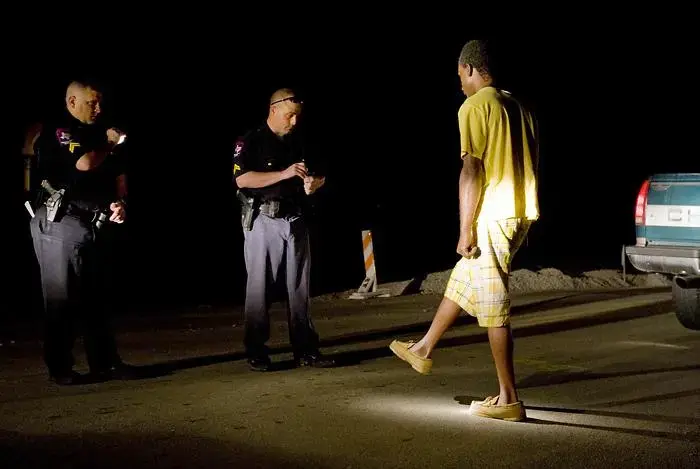
- What the officer observes: The person raises one foot about six inches off the ground and counts aloud. The officer watches for swaying, arm use for balance, hopping, and putting the foot down.
- What can affect performance: Injuries, balance problems, age, footwear, and an uneven surface can all change how someone performs.
None of these tests measures alcohol directly. Each records how someone performed a task.
What Do Field Sobriety Tests Actually Prove?
They show how a person performed specific tasks at the roadside. On their own, they prove little more. The results of a field sobriety test Michigan officers administer are observations, not measurements.
A field sobriety test does not directly measure a driver’s blood alcohol concentration.
Two statements sound alike but are not interchangeable:
- “The officer observed signs of impairment.”
- “The test proved the driver was intoxicated.”
The first describes what an officer saw. The second is a legal conclusion. Michigan’s statute treats impairment and a BAC of 0.08 or more as separate questions (MCL 257.625a(7)). A roadside exercise speaks only indirectly to the first and cannot answer the second.
Officers and courts look at the totality of the circumstances. No single result automatically creates probable cause. The inputs often include driving behavior, odor of alcohol, speech, coordination, statements, a PBT result, a chemical test result, and conditions at the stop.
A PBT can support an arrest in whole or in part. At trial, its results are admissible only for limited purposes, such as helping a court decide a challenge to the arrest’s validity.
How Accurate Are Field Sobriety Tests Before a DUI Arrest?
Accurate enough that NHTSA calls the battery validated, but not accurate enough to treat any single roadside result as proof. People searching “how accurate are field sobriety tests before DUI arrest” usually want one number, and that number needs context.
- Testing conditions: Seven San Diego police officers were trained in the battery with slightly modified scoring, and the study covered 297 motorists.
- What it measured: How often the officers’ judgment about whether a BAC was above or below 0.08 matched the measured result: 91 percent, or up to 94 percent if some explanations for false positives are accepted. The average measured BAC was 0.122.
The limits matter:
- The drivers were people officers had stopped on patrol, and many were well over 0.08. That is not a random group, and it can make sorting easier than it would be near the limit.
- The figure reflects trained officers making overall decisions with the full battery, not the reliability of one test on one person.
- NHTSA’s own manual says the validation applies only when tests are given as prescribed, and that its procedures describe ideal conditions.
Are Field Sobriety Tests Mandatory in Michigan?
Drivers often ask, Are field sobriety tests mandatory? In Michigan, the roadside exercises are generally treated as voluntary. Every field sobriety test Michigan officers request is a request, not an order backed by a statutory penalty. Three categories need separating:
- Roadside exercises (HGN, walk-and-turn, one-leg stand): The breath and chemical test statutes do not cover them, and declining does not trigger the penalties those statutes create. An officer may still note the refusal and rely on other observations.
- Preliminary breath test: Under MCL 257.625a(2), an officer with reasonable cause may require one. Refusing is a civil infraction. Commercial vehicle operators face a misdemeanor.
- Chemical tests after arrest: These fall under implied consent. A driver who refuses will not be tested without a court order, but the officer may seek one. Refusal results in license suspension and six points. A refusal is admissible only to show a test was offered.
That last limit was written for chemical tests, so no one should assume it protects a person who declines roadside exercises. Mark’s guide to refusing a field sobriety test in Michigan covers this in more depth.
What Happens After a Driver Performs Field Sobriety Tests?
A typical OWI arrest Grand Rapids drivers face follows a rough sequence, though no two investigations are identical:
- Traffic stop: The officer has a reason for the stop, such as a moving violation or an equipment problem.
- Officer observations: The officer notes driving, odor, speech, and responses to questions.
- Roadside testing: Field sobriety exercises and often a PBT.
- Additional investigation: More questions, more observation, and a decision about whether the facts support an arrest.
- Possible arrest: The officer decides whether there is probable cause.
- Chemical testing: Breath, blood, or urine testing after arrest.
- Charging decision: A prosecutor reviews the reports and evidence and decides what to charge.
Field sobriety tests are one piece of this chain. Each stage can raise its own legal questions, and reviewing them is a core part of our guide on OWI and DUI defense work in Grand Rapids.
Can You Fail a Field Sobriety Test?
Not in the way you fail an exam. Field sobriety tests are not conventional pass/fail tests. Officers count and document specific clues, and many add narrative observations. NHTSA’s training uses decision points, such as four or more of six HGN clues. A decision point is a tool for the officer, not a verdict.
The instructions and the officer’s wording matter. NHTSA’s manual scripts the instructions and has the officer confirm the person understands them. Clues also have definitions. In the walk-and-turn, stopping while walking is a clue, but walking slowly is not. A missed heel-to-toe step means a gap of half an inch or more.
So “I failed” is not a legal finding. The substantial-compliance language in MCL 257.62a is one reason how a test was given can matter.
What Should You Do If You Are Facing an OWI Investigation?
If an OWI arrest in Grand Rapids police may make is possible, or has already happened, a few basics help:
- Stay calm and avoid arguing. Arguments rarely help and are often recorded.
- Remember that statements count. What you say at the roadside can become part of the investigation.
- Know the difference between voluntary roadside exercises and legally required testing.
- Take chemical-testing requirements seriously. Mark’s guide to Michigan’s implied consent laws explains what a refusal can set in motion, including a short deadline to challenge a suspension.
- Ask about speaking with a lawyer when appropriate.
- Never lie, flee, or interfere with evidence. Any of these can make matters worse.
- Write down what you remember: location, lighting, footwear, instructions, and timeline.
A Kent County DUI attorney field sobriety test review works best when those details are still fresh.
What Can a Michigan OWI Lawyer Review?
An attorney can examine the full circumstances of a stop instead of viewing a field sobriety test in isolation. A Kent County DUI attorney field sobriety test review starts with the video and the instructions actually given.
A lawyer may review:
- Traffic-stop circumstances
- Officer observations
- Body-camera and dash-camera footage
- How the field sobriety tests were administered
- Instructions given
- Road and weather conditions
- Preliminary breath testing
- Chemical-test results
- Police reports
- Timing of the investigation
- Whether required procedures were followed
Mark Caldwell reviews the facts and explains the legal issues specific to each person’s case. He handles OWI and other criminal defense matters in West Michigan. No lawyer can promise an outcome, and every case depends on its facts.
Final Thoughts
A field sobriety test Michigan officers administer gives them observations relevant to an OWI investigation. It does not directly measure BAC, and it does not automatically determine guilt. What it means depends on how it was given, where, and alongside what other evidence.
If you have been stopped, tested, arrested, or charged, talk with attorney Mark Caldwell about the circumstances. e Contact Mark Caldwell to request a free consultation. Outcomes depend on the facts of each case.
Frequently Asked Questions
- What is a field sobriety test in Michigan?
It is a roadside exercise an officer uses to look for signs of impairment. A field sobriety test Michigan police give is not a chemical test and does not measure BAC. - Are field sobriety tests mandatory in Michigan?
Generally, no. Roadside exercises are treated as voluntary. Refusing a PBT is a civil infraction, and refusing a post-arrest chemical test carries license consequences. - Can you refuse a field sobriety test in Michigan?
In general, yes. Declining does not trigger the penalties that apply to a PBT or chemical test refusal. An officer may still note it and rely on other observations. - Can you be arrested for OWI without taking a field sobriety test?
It is possible. An arrest depends on probable cause from the whole picture, such as driving, odor, speech, statements, and a PBT result. Completing roadside exercises is not a required step. - What are the three standardized field sobriety tests?
Horizontal gaze nystagmus, walk-and-turn, and one-leg stand. All three come from NHTSA training.