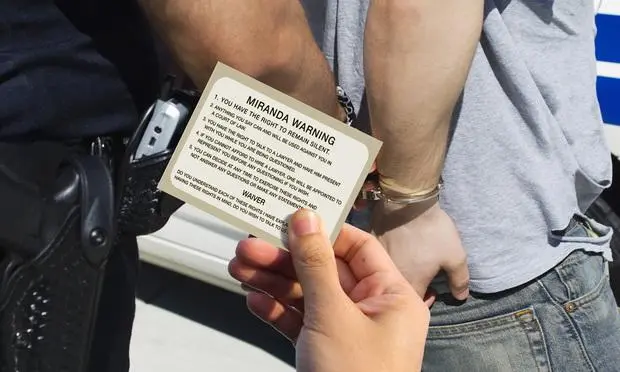
A Miranda warning informs a person of the right to remain silent, the right to an attorney during questioning, and the risk that statements may be used in court. Michigan police must provide these warnings before custodial interrogation. An arrest alone does not always trigger the requirement. Routine traffic stops, voluntary conversations, and certain emergency questions may fall outside Miranda protections. If police violate the rule, a court may exclude statements obtained through the unlawful questioning.
_____________________________________________________________________
Police do not have to read your Miranda rights every time they question you. Under the Fifth Amendment, officers must provide these warnings before conducting a custodial interrogation. This means you must be in custody and facing questions or police conduct likely to produce an incriminating response.
What is a Miranda warning? Understanding it can protect you during a criminal investigation. The circumstances of your detention, the questions officers ask, and your responses can affect whether Miranda protections apply.
Key Takeaways
- Miranda warnings apply before custodial interrogation, not every police interaction.
- Police must establish custody and interrogation for the requirement to apply.
- Routine traffic stops usually do not qualify as Miranda custody.
- A Miranda violation does not automatically dismiss criminal charges.
- Courts examine the circumstances before deciding whether statements are admissible.
What Is a Miranda Warning?
A Miranda warning is a notice police must give before questioning someone in custody about a suspected crime. It protects the person’s Fifth Amendment right against compelled self-incrimination.
The warning generally communicates four rights:
- The right to remain silent: You do not have to answer police questions.
- Use of your statements: Anything you say can be used against you in court.
- The right to an attorney: You can have a lawyer present during questioning.
- Appointed legal counsel: If you cannot afford an attorney, one can be appointed before questioning if you qualify.
The exact wording can vary between police departments. Officers do not have to recite one specific script. They must communicate the required rights effectively.
Does a Miranda Warning Mean You Are Under Arrest?
No. Receiving a Miranda warning does not automatically mean you have been formally arrested or charged.
Police may provide the warning before questioning someone who is already under arrest. They may also provide it before a custodial interview when no formal arrest has occurred. The warning signals that officers intend to conduct questioning under circumstances that trigger Miranda protections.
A person can also face an investigation without receiving a warning. That does not automatically mean the police violated constitutional rights.
When Must Michigan Police Give Miranda Warnings?
Michigan police must provide Miranda warnings before questioning someone who is in custody. Both legal conditions must exist.
Custody + Interrogation = Miranda Requirement
If either condition is missing, Miranda warnings are generally not required.
-
When Does Police Custody Begin?
Custody means more than being questioned by an officer or becoming a suspect. Courts examine whether a reasonable person in the same circumstances would feel free to end the questioning and leave.
Formal arrest usually qualifies as custody. Certain situations involving significant restrictions on movement can also qualify.
Courts consider several circumstances:
- Where the questioning takes place.
- How long the questioning lasts.
- Whether officers use physical restraints.
- Whether officers tell the person they can leave.
- Whether police control the interview environment.
- Whether the person is released after questioning.
No single factor decides the issue. Courts examine the entire situation.
-
What Counts as Police Interrogation?
Interrogation includes direct questions and certain police actions designed to produce an incriminating response.
Officers do not have to ask, “Did you commit the crime?” for their conduct to qualify.
Consider this example:
A suspect is sitting in a police interview room. An officer asks where the suspect was during a burglary. The officer then presents evidence and asks the suspect to explain it.
These questions seek information that could connect the person to the alleged offense. They qualify as interrogation.
The rule also covers the functional equivalent of direct questioning. Police conduct may trigger Miranda protections when officers should reasonably expect it to produce an incriminating response.
What If Police Only Ask for Basic Information?
Routine administrative questions do not automatically qualify as interrogation.
Officers may ask for identifying details during booking, such as a person’s name and date of birth. These questions generally serve administrative purposes rather than obtaining evidence about a crime.
The actual purpose and circumstances matter. A question that appears administrative could require further legal examination if officers use it to obtain incriminating information.
Miranda Rights in Michigan: What Does State Law Say?
Miranda Rights in Michigan come from the Fifth Amendment to the U.S. Constitution and the corresponding protection in Article 1, Section 17 of the Michigan Constitution.
Michigan courts follow the custodial interrogation standard established in Miranda v. Arizona.
In People v. Elliott, 494 Mich. 292 (2013), the Michigan Supreme Court examined when Miranda protections apply. The decision addressed the difference between restrictions on freedom of movement and the coercive circumstances associated with custodial interrogation.
The Michigan Court of Appeals also discussed this requirement in People v. Steele, 292 Mich. App. 308 (2011).
These decisions reinforce an important point: police questioning does not automatically require Miranda warnings. The legal circumstances surrounding the questioning determine whether the rule applies.
When Are Miranda Rights Not Required in Michigan?
Not every interaction with police triggers Miranda protections. Certain situations fall outside the custodial interrogation requirement.
The following examples explain when Miranda rights are not required.
Routine Traffic Stops
Police generally do not need to give Miranda warnings during an ordinary traffic stop. An officer may ask about your license, registration, destination, or the reason for a traffic violation. A routine traffic stop usually does not create the level of custody required under Miranda.
The situation can change if officers arrest the driver or impose restrictions that turn the encounter into custodial questioning.
For drivers facing an OWI investigation, the distinction between roadside questioning and post-arrest interrogation can matter. Mark Caldwell provides legal representation through his Michigan OWI and DUI defense services.
Voluntary Conversations With Police
Police can ask questions during a voluntary conversation without automatically providing Miranda warnings.
For example, an officer may approach someone outside a business and ask whether they witnessed an incident. If the person remains free to leave, the conversation generally does not qualify as custodial interrogation.
A person becoming a suspect does not automatically change that result.
Spontaneous Statements
Miranda protections generally apply to statements obtained through custodial interrogation. They do not automatically cover statements someone makes voluntarily without police questioning.
For example, a person in custody might suddenly admit involvement in an offense without any officer asking a question or using conduct designed to obtain that admission.
That statement may remain admissible, depending on the circumstances.
Routine Booking Questions
Police can generally ask administrative questions during the booking process without giving Miranda warnings.
These questions may include:
- Full name.
- Date of birth.
- Address.
- Other basic identification details.
Questions about the alleged offense are different. Officers cannot automatically treat investigative questions as routine booking questions.
Undercover Police Conversations
Miranda warnings are generally unnecessary when an undercover officer questions a suspect who does not know they are speaking with law enforcement.
The U.S. Supreme Court addressed this issue in Illinois v. Perkins, 496 U.S. 292 (1990).
The Court explained that the coercive police-dominated atmosphere associated with custodial interrogation was absent in that situation.
Immediate Public Safety Emergencies
Police may ask certain questions before giving Miranda warnings when an immediate safety threat exists.
For example, officers arrest someone suspected of carrying a firearm. They ask where the weapon is located because another person could access it.
In New York v. Quarles, 467 U.S. 649 (1984), the U.S. Supreme Court recognized this public safety exception.
The exception is limited. Officers must have an objectively reasonable need to address an immediate danger. It does not give police unlimited authority to question suspects without warnings.
What Happens If Michigan Police Fail to Give a Miranda Warning?
A Miranda violation can affect whether prosecutors may use a suspect’s statements in court. If police conduct custodial interrogation without the required warnings, the defense may challenge the admissibility of statements obtained through that questioning.
A judge examines the circumstances and determines whether the statements should be excluded.
Can a Court Suppress Statements Made Without Miranda Warnings?
Yes. A court may suppress statements obtained through custodial interrogation when police fail to provide the required warnings.
For example, an officer arrests someone and takes them to an interview room. The officer then asks questions about the alleged offense without first giving Miranda warnings. If the suspect makes incriminating statements, the defense may challenge their admission.
The prosecution generally cannot use statements obtained in violation of Miranda during its case-in-chief. The Michigan Judicial Institute explains this rule in its Evidence Benchbook.
Does a Miranda Violation Dismiss the Entire Criminal Case?
No. A Miranda violation does not automatically dismiss charges or invalidate every piece of evidence.
The court examines what evidence police obtained and how they obtained it. Physical evidence may remain admissible even when an unwarned statement is excluded.
For example, an inadmissible statement might reveal the location of a weapon. The weapon itself may still be admissible under the rule established in United States v. Patane, 542 U.S. 630 (2004), if the statement was voluntary.
Other evidence may also support prosecution independently of the challenged statement. The defense must examine the specific evidence and constitutional issues involved.
Can You Waive Your Miranda Rights?
Yes. A person can voluntarily give up Miranda protections after receiving and understanding the required warnings. Police often ask whether the suspect understands the rights and wishes to answer questions.
A valid waiver must be voluntary, knowing, and intelligent.
What Does Waiving Your Rights Mean?
Waiving your rights means agreeing to answer police questions without exercising the right to remain silent or the right to have an attorney present. A signature on a waiver form is not the only way to establish a waiver. Courts may consider a person’s words and conduct.
Still, silence alone does not automatically establish a valid waiver. The prosecution must establish that the waiver meets the required legal standard.
What Should You Do If Police Want to Question You?
If police want to interview you about a criminal investigation, take the situation seriously. You can protect your position without arguing with officers or making unnecessary statements.
Consider these steps:
- Stay calm and respectful. Do not argue, resist, or interfere with police duties.
- Ask whether you are free to leave. This can help you understand the nature of the encounter.
- Avoid guessing or speculating. Inaccurate answers can create additional problems.
- Clearly invoke your rights. State that you want to remain silent and speak with an attorney.
- Do not sign statements you do not understand. Ask for legal advice before agreeing to an interview or waiver.
- Contact a criminal defense attorney. Discuss the circumstances of the questioning and any statements you already made.
If the questioning involves an OWI investigation, the distinction between roadside tests and chemical testing also matters. Read Mark Caldwell’s explanation of Michigan field sobriety tests and what they actually prove.
A Miranda warning does not cover every police procedure. For example, chemical testing after an OWI arrest raises separate legal questions under Michigan’s implied consent rules.
Conclusion
Understanding what a Miranda warning is can help you make informed decisions during a criminal investigation. Michigan police must provide these warnings before custodial interrogation, but not every arrest or police conversation triggers the requirement. A violation may give the defense grounds to challenge statements, although it does not automatically dismiss charges.
Speak with Mark Caldwell about your situation. Contact Mark Caldwell to schedule a free consultation and discuss your legal rights and possible next steps.
Frequently Asked Questions
- What is a Miranda warning in Michigan?
A Miranda warning explains your right to remain silent, the use of your statements in court, and your right to an attorney during custodial questioning. Police must provide these warnings before custodial interrogation. An arrest alone does not always trigger this requirement.
- Do Michigan police have to read Miranda rights during every arrest?
No. Police do not have to give Miranda warnings automatically during every arrest. The requirement applies before custodial interrogation. If officers arrest someone but do not question them about a crime, Miranda warnings may not be necessary at that time.
- When Miranda rights are not required, can police still question a suspect?
Yes. Police can question people during voluntary conversations, routine traffic stops, and certain other encounters without providing Miranda warnings. The requirement changes when the circumstances become custodial, and officers begin interrogation.
- Can I refuse to answer police questions in Michigan?
Yes. You generally have the right to remain silent when questioned about suspected criminal activity. You should clearly invoke that right rather than assume your silence communicates your decision. You can also request an attorney before answering investigative questions.
- Can a Miranda violation get criminal charges dismissed?
Not automatically. A court may exclude statements obtained through custodial interrogation without proper warnings. The prosecution may still proceed using other admissible evidence. Whether suppression affects the case depends on the evidence and the legal issues involved.
- Can police question someone without a lawyer present?
Police can question someone who voluntarily agrees to speak after receiving and validly waiving Miranda rights. If a person clearly requests an attorney during custodial interrogation, police generally must stop questioning until counsel is present.
- Do Miranda rights apply during a Michigan OWI investigation?
Miranda protections may apply during custodial interrogation in an OWI investigation. Routine roadside questioning generally does not trigger the requirement. Questions asked after an arrest may require warnings, depending on the circumstances.