A positive roadside saliva test in Michigan shows that a drug was present above a device cutoff. It does not prove impairment. The Michigan State Police pilot matched the THC panel to blood results 87.9% of the time. The agency states that no roadside result decides impairment. Current law limits roadside oral fluid testing to certified drug recognition experts. House Bills 4390 and 4391 would extend it to every peace officer. Both bills passed the House 61 to 44 and were still in a Senate committee in the latest reports. A positive screen can still support an arrest and a blood draw.
________________________________________________________________________
A swab, five minutes, and a handheld screen that reads “positive.” That is the roadside drug test Michigan lawmakers want every officer to carry. A positive result does not prove you were impaired. It shows a drug at or above a preset cutoff. Michigan’s own pilot data and Michigan law point to the same limit.
Key Takeaways
- A saliva screen detects a drug above a cutoff. It cannot measure impairment.
- In the state pilot, about 1 in 8 THC results did not match blood.
- Current law lets only certified drug recognition experts request the test.
- HB 4390 passed the House in July 2025. It had not cleared the Senate committee as of April 2026.
- A 2019 state commission found no scientifically supported THC threshold for impairment.
- Refusing a preliminary roadside test is a civil infraction, not a crime.
Can Police Test for THC on the Roadside in Michigan?
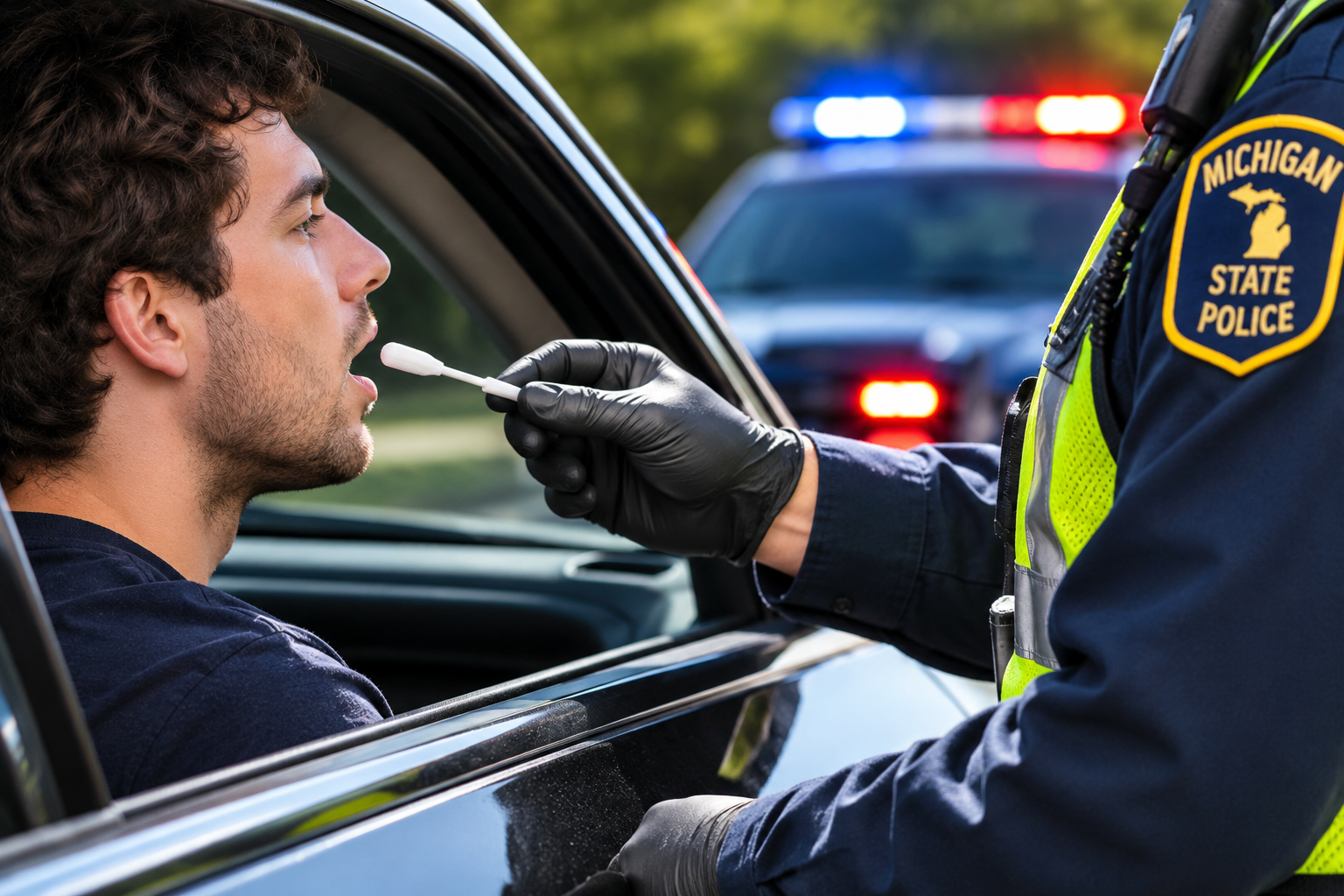
Yes, but only in a narrow way. Current law lets certified drug recognition experts (DREs) request a preliminary oral fluid analysis, according to the House Fiscal Agency. Most patrol officers cannot. The practice grew from a pilot in five counties in 2017 and 2018. It expanded to 69 counties in 2019 and 2020.
A preliminary oral fluid analysis is an on-site saliva test, run by an officer, that screens for a controlled substance. It works like the preliminary breath test used for alcohol.
How the screen works in practice:
- The device tests six drug classes: amphetamine, benzodiazepines, THC, cocaine, methamphetamine, and opiates.
- It reports positive, negative, or invalid in about five minutes.
- It usually follows field sobriety tests rather than replacing them.
- A blood test, or a lab oral fluid test under the proposed bills, confirms the result later.
Mark Caldwell, a Grand Rapids OWI defense attorney, reviews each of these steps when a client faces a drugged driving arrest.
What Does a Positive Saliva Result Actually Show?
Myth: A positive result means the driver was high.
Fact: It means the sample held THC at or above 25 ng/mL, the cutoff the manufacturer set. The device reports only positive, negative, or invalid. It gives no concentration. The State Police report says a roadside result, positive or negative, does not decide impairment.
Myth: Saliva and blood numbers line up.
Fact: They do not. The same report cites research that 1 ng/mL of THC in blood equals roughly 44 ng/mL in oral fluid.
Myth: A negative result clears the driver.
Fact: Of 242 negative THC screens in the pilot, 56 had THC in blood.
Are Roadside Drug Tests Accurate?
Accurate for what? The pilot answers that question for drug presence, not impairment. Phase II ran from October 2019 to September 2020. The Michigan State Police Phase II report logged 693 incidents and 661 roadside tests from 131 DREs at 65 agencies. Each device result was compared to blood.
| Drug Panel | Positive Screens that Matched Blood | Overall Accuracy |
| Methamphetamine | 84.6% | 95.2% |
| Cocaine | 68.6% | 94.4% |
| THC | 95.5% | 87.9% |
| Amphetamine | 69.4% | 85.7% |
| Benzodiazepines | 40.0% | 82.6% |
| Opiates | 35.4% | 90.7% |
Source: Michigan State Police, Oral Fluid Roadside Analysis Pilot Program Phase II, January 2021.
What the THC numbers say
THC performed best on positives. Of 355 positive screens, 339 matched blood. That is 95.5%. Negatives were weaker, as the 56 misses above show.
So are roadside drug tests accurate enough to justify a blood draw? For THC presence, the pilot says largely yes. For impairment, it says nothing.
What the numbers leave out
- Suspected drivers only: every pilot driver was already under a DRE investigation. Results may not carry over to wider use.
- A generous blood benchmark: the comparison counted blood as positive when it showed drug metabolites.
- Weak spots: only 40.0% of benzodiazepine positives and 35.4% of opiate positives matched blood.
- The critics’ read: the ACLU of Michigan says nearly 11% of all pilot tests gave results that did not match blood.
Any roadside drug test Michigan officers run for opiates or benzodiazepines deserves extra scrutiny.
Michigan House Bill 4390 Roadside Saliva Test: What Would Change?
House Bill 4390, sponsored by Rep. Brian BeGole, has a companion, House Bill 4391, sponsored by Rep. Julie Rogers. The Michigan House Bill 4390 roadside saliva test proposal would let any peace officer request a swab. Results could support an arrest.
Court use would stay narrow. The House Fiscal Agency analysis says a result could help a court judge an arrest’s validity. It could also rebut testimony about a conflicting blood or urine result. Labs could test oral fluid in place of a blood draw. Refusing the swab would remain a civil infraction. Each bill takes effect 90 days after enactment, and neither works alone.
Support comes from the Michigan State Police, the Michigan Sheriffs’ Association, MADD, and AAA. Rep. BeGole points to drug involvement in nearly a quarter of the state’s 1,021 fatal crashes in 2023. The ACLU of Michigan and the Michigan Weedsters Association oppose the bills. The Criminal Defense Attorneys of Michigan took a neutral position.
Where the bills stand:
- April 24, 2025: introduced in the House.
- May 22, 2025: House committee approves HB 4390, 5 to 0.
- July 1, 2025: House passes both bills, 61 to 44.
- July 17, 2025: Senate refers them to the Civil Rights, Judiciary, and Public Safety Committee.
- April 2026: reports still place both bills in that committee.
Check the Michigan Legislature’s bill page for the current status.
Can THC in Saliva Prove Impairment in a Michigan Courtroom?
No. A saliva screen is a starting point. Michigan prosecutors build drugged driving cases on one of two paths.
Path One: Proving The Drug Affected Your Driving
Operating while intoxicated and impaired driving charges require proof that a drug affected your driving. Driving behavior, officer observations, and field sobriety tests carry that weight. A saliva number does not. Our guide explains what prosecutors must prove in an OWI case.
Path Two: Proving A Schedule 1 Substance Was Present
MCL 257.625(8) bars driving with any amount of a Schedule 1 substance in the body. Marijuana is on that list. A roadside screen has limited courtroom use, so this charge usually rests on a blood or urine result. In People v. Koon, the Michigan Supreme Court held that this rule does not apply to registered medical marijuana patients. Those patients can still face charges if they are impaired.
Why Presence Is A Weak Stand-In For Impairment
A state commission studied this question for nearly two years. In March 2019, the Impaired Driving Safety Commission found a poor link between THC levels and driving impairment. Michigan Public reported that it advised against a THC limit. It urged roadside sobriety tests and more officer training instead.
Where the swab fits
Many drivers ask if police test for THC on the roadside in Michigan and stop there. The better question is what follows the swab. A positive screen can support an arrest. An arrest can lead to a blood draw. A blood result can support a presence charge. The saliva result is the first link in that chain, which makes the arrest decision the real battleground.
Six Points a Defense Lawyer Checks After a Positive Saliva Screen
Each point below shapes a roadside drug test Michigan defense. A criminal defense lawyer in Grand Rapids reviews the police report, video, and lab records for all six.
- Reasonable cause. Did the officer have grounds to suspect drug impairment before requesting the swab?
- Officer qualification. Current law requires a certified DRE. Was the officer one?
- Test procedure. Did the officer collect enough fluid and follow the device steps? The pilot logged 11 invalid THC results.
- Timing. How long passed between driving, the swab, and any blood draw? The pilot notes blood draws can happen hours after police contact.
- What the lab measured. Did the blood result show active THC or only metabolites?
- Your status. Registered medical marijuana patients have protection under Koon. Prescription medications also fall in tested drug classes.
What Should You Do If an Officer Asks for a Saliva Swab?
At the roadside
Stay calm and polite. Hand over your license, registration, and insurance. Keep answers short. Do not volunteer when you last used cannabis or any medication. Questions at a stop often come before any warning. Our guide explains when Michigan police must give a Miranda warning.
Declining a preliminary roadside test is a civil infraction, not a crime, under the pilot rules and the proposed bills. Ask a lawyer how that choice applies to your situation.
After an arrest
A later blood or urine test falls under Michigan’s implied consent law. Refusing it suspends your license, according to the Michigan State Police. Write down the time of the stop, the swab, the arrest, and any blood draw.
If your license is already suspended
If a suspension or revocation has already happened, license restoration help in Grand Rapids can map your path back to driving.
In Conclusion
A saliva screen flags a drug. It cannot show impairment, and Michigan’s own data says so. If a roadside stop has put you under investigation, the details decide the outcome. Reasonable cause, officer training, timing, and lab results all matter. Mark Caldwell has handled OWI and criminal defense cases in Grand Rapids for nearly two decades. Do not wait for your first court date to ask questions. Schedule a free consultation with Mark Caldwell today.
Frequently Asked Questions
- Is a roadside saliva test required in Michigan?
A certified DRE can request it when the DRE has reasonable cause to suspect drug impairment. Refusing is a civil infraction, not a crime. A later blood or urine test after arrest is treated differently under implied consent. - Can a saliva test show I was high while driving?
No. It shows a drug above a device cutoff. The State Police pilot report says a roadside result does not decide impairment. Officer observations and field sobriety tests address impairment. - Can I be convicted based only on a roadside swab?
Unlikely. The House Fiscal Agency summary describes limited courtroom use for a preliminary result. Prosecutors would still need proof of impairment, or a blood or urine result for a presence charge. - Does a medical marijuana card protect me?
Partly. Under People v. Koon, the any-amount rule does not apply to registered patients. You can still be charged for driving while impaired. - Which drugs does the Michigan roadside device screen for?
The pilot device tests for amphetamine, benzodiazepines, THC, cocaine, methamphetamine, and opiates. Results appear in about five minutes. A positive for a prescribed medication in these classes still needs context. - Is the roadside saliva bill law yet?
Not as of the latest reports from April 2026. HB 4390 passed the House but sat in a Senate committee. Until the Senate acts, a roadside drug test Michigan officers can request stays limited to certified DREs.